

Is Color A Chemical Or Physical Change
3.03: Physical and Chemical Changes
- Page ID
- 178122
Learning Objectives
- Label a change equally chemical or physical.
- List bear witness that tin indicate a chemic change occurred.
Change is happening all around us all of the time. But equally chemists have classified elements and compounds, they have also classified types of changes. Changes are either classified as concrete or chemical changes. Chemists learn a lot about the nature of matter by studying the changes that affair can undergo. Chemists make a distinction between two dissimilar types of changes that they written report - physical changes and chemic changes.
Physical Change
Physical changes are changes in which no bonds are cleaved or formed. This means that the same types of compounds or elements that were at that place at the beginning of the modify are there at the end of the alter. Because the ending materials are the aforementioned equally the offset materials, the backdrop (such equally colour, humid indicate, etc) will likewise be the same. Physical changes involve moving molecules around, just not changing them. Some types of physical changes include:
- Changes of state (changes from a solid to a liquid or a gas and vice versa)
- Separation of a mixture
- Physical deformation (cutting, denting, stretching)
- Making solutions (special kinds of mixtures)
As an ice cube melts, its shape changes equally it acquires the ability to flow. Withal, its limerick does not change. Melting is an case of a physical change. A physical change is a modify to a sample of matter in which some properties of the material alter, but the identity of the affair does not. When we heat the liquid water, it changes to h2o vapor. But even though the physical properties have changed, the molecules are exactly the same as earlier. Nosotros still have each water molecule containing ii hydrogen atoms and ane oxygen atom covalently bonded. When you have a jar containing a mixture of pennies and nickels and you lot sort the mixture so that you lot have one pile of pennies and some other pile of nickels, you have not altered the identity of either the pennies or the nickels - yous've only separated them into two groups. This would be an example of a physical alter. Similarly, if you have a piece of paper, you don't change information technology into something other than a piece of paper by ripping information technology up. What was paper before you started tearing is still newspaper when you're done. Again, this is an example of a concrete change.
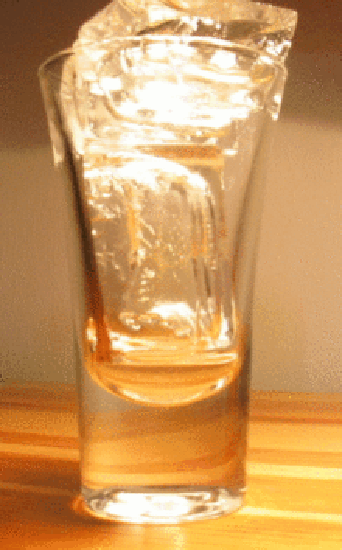
Figure \(\PageIndex{1}\): Water ice Melting is a physical change. When liquid water (\(H_2O\)) freezes into a solid state (water ice), it appears changed; All the same, this modify is only physical every bit the the composition of the constituent molecules is the same: xi.19% hydrogen and 88.81% oxygen by mass. Image used with permission (Public Domain; Moussa).
Physical changes can further be classified as reversible or irreversible. The melted ice cube may be refrozen, so melting is a reversible physical change. Concrete changes that involve a change of state are all reversible. Other changes of state include vaporization (liquid to gas), freezing (liquid to solid), and condensation (gas to liquid). Dissolving is also a reversible physical change. When common salt is dissolved into water, the salt is said to have entered the aqueous state. The salt may be regained by humid off the h2o, leaving the common salt behind.
Chemic Change
Chemical changes occur when bonds are broken and/or formed betwixt molecules or atoms. This ways that one substance with a sure set of backdrop (such as melting betoken, colour, taste, etc) is turned into a different substance with dissimilar backdrop. Chemic changes are frequently harder to reverse than concrete changes.
One skillful example of a chemical change is called-for a candle. The act of burning paper really results in the germination of new chemicals (carbon dioxide and water, to be exact) from the burning of the wax. Another example of a chemical alter is what occurs when natural gas is burned in your furnace. This time, on the left we have a molecule of methane, \(\ce{CH_4}\), and ii molecules of oxygen, \(\ce{O_2}\), while on the right we accept two molecules of water, \(\ce{H_2O}\), and 1 molecule of carbon dioxide, \(\ce{CO_2}\). In this case, not only has the appearance changed, only the structure of the molecules has also changed. The new substances do not accept the aforementioned chemical properties as the original ones. Therefore, this is a chemic alter.
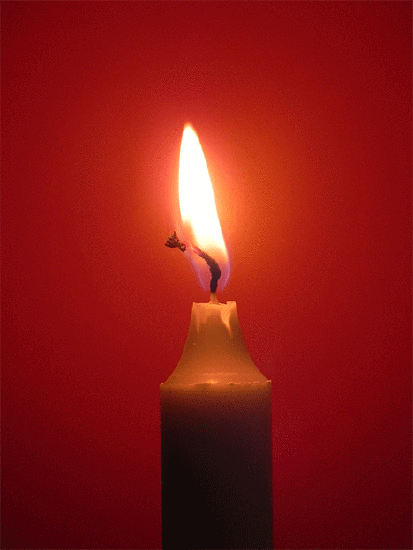
We tin can't actually see molecules breaking and forming bonds, although that'southward what defines chemical changes. We have to brand other observations to betoken that a chemic modify has happened. Some of the testify for chemical change will involve the energy changes that occur in chemical changes, only some testify involves the fact that new substances with different backdrop are formed in a chemical modify.
Observations that help to indicate chemical change include:
- Temperature changes (either the temperature increases or decreases)
- Light is given off
- Unexpected colour changes (a substance with a different color is made, rather than merely mixing the original colors together)
- Bubbles are formed (simply the substance is not boiling - you lot made a substance that is a gas at the temperature of the beginning materials, instead of a liquid)
- Different smell or taste (do non taste your chemistry experiments, though!)
- A solid forms if ii articulate liquids are mixed (wait for floaties - technically called a precipitate)
Example \(\PageIndex{1}\)
Label each of the post-obit changes equally a physical or chemical change. Give prove to support your answer.
- Boiling water
- A nail rusting
- A green solution and colorless solution are mixed. The resulting mixture is a solution with a pale green color.
- Ii colorless solutions are mixed. The resulting mixture has a yellowish precipitate.
Solution:
- Physical: boiling and melting are concrete changes. When h2o boils no bonds are cleaved or formed. The change could be written: \(\ce{H_2O} \left( 50 \right) \rightarrow \ce{H_2O} \left( g \right)\)
- Chemical: The nighttime grey blast changes color to form an orangish flaky substance (the rust); this must exist a chemical change. Color changes signal chemic change. The following reaction occurs: \(\ce{Fe} + \ce{O_2} \rightarrow \ce{Fe_2O_3}\)
- Physical: because none of the backdrop changed, this is a physical modify. The green mixture is still green and the colorless solution is still colorless. They have only been spread together. No color modify occurred or other evidence of chemical change.
- Chemic: the formation of a precipitate and the colour change from colorless to xanthous bespeak a chemical change.
Practice \(\PageIndex{one}\)
Label each of the post-obit changes as a physical or chemical modify.
- A mirror is cleaved.
- An iron nail corroded in moist air
- Copper metallic is melted.
- A catalytic converter changes nitrogen dioxide to nitrogen gas and oxygen gas.
- Answer a:
- physical change
- Answer b:
- chemical change
- Answer c:
- physical modify
- Respond d:
- chemical change
Summary
- Chemists make a distinction between ii different types of changes that they report - physical changes and chemic changes.
- Physical changes are changes that do non alter the identity of a substance.
- Chemical changes are changes that occur when one substance is turned into another substance.
- Chemical changes are frequently harder to opposite than concrete changes. Observations that indicate a chemical modify occurred include color change, temperature change, light given off, formation of bubbling, formation of a precipitate, etc.

Source: https://chem.libretexts.org/Courses/Los_Angeles_Trade_Technical_College/Chem_51/03%3A_Matter/3.03%3A_Physical_and_Chemical_Changes
Posted by: friendhintailging.blogspot.com
0 Response to "Is Color A Chemical Or Physical Change"
Post a Comment